
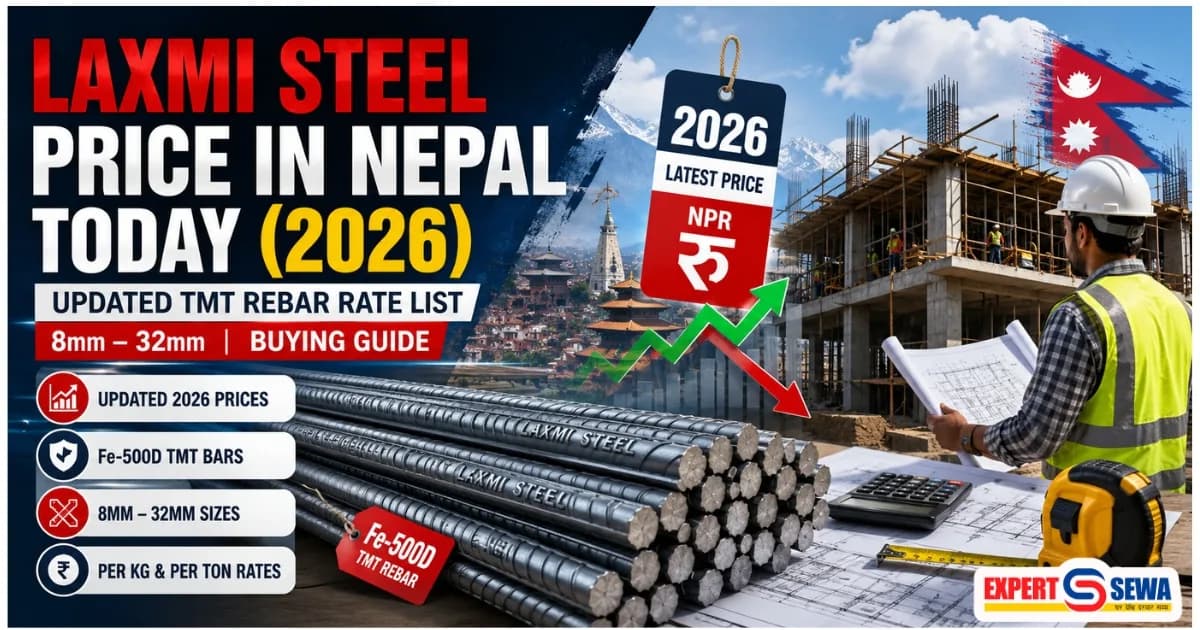
Laxmi Steel Price in Nepal Today: The Definitive 2026 Buyer & Structural Guide
1. Introduction to Steel Reinforcement in Nepal
In reinforced cement concrete (RCC) construction, concrete excels under compressive stress but exhibits low tensile strength. Thermo-Mechanically Treated (TMT) steel rebars provide the required tensile capacity, transforming plain concrete into durable structural components capable of withstanding gravity loads, wind pressure, and severe seismic forces.
Nepal sits directly along the active tectonic boundary between the Indian and Eurasian tectonic plates, making seismic safety a foundational requirement for all civil structures. Structural failures observed during major seismic events—such as the 2015 Gorkha earthquake—demonstrated that inadequate reinforcement quantity, inferior rebar ductility, or low-grade steel can lead to catastrophic structural failure at beam-column joints.
Selecting high-quality steel is not merely an expense; it is a primary safety investment. Laxmi Steels Limited has established itself as one of Nepal’s foremost manufacturers of high-yield TMT rebar. Understanding current Laxmi Steel prices in Nepal today enables homeowners, structural engineers, and contractors to plan material procurement efficiently without compromising structural integrity.
2. Laxmi Steel Price in Nepal Today (2026 Overview)
The market rate for steel rebars in Nepal fluctuates depending on global scrap steel pricing, Indian billet export tariffs, local transport logistics, and currency exchange rates. As of mid-2026, the retail price for Laxmi Steel TMT bars in Nepal generally ranges between NPR 106 and NPR 112 per kilogram before local transport and dealer-specific bulk adjustments.
2026 Market Summary Highlights
Base Rate Range: NPR 106 – NPR 112 per kg (Ex-Factory / Retail)
Average Metric Ton Rate: NPR 106,000 – NPR 112,000 per MT
Standard Manufacturing Grade: Fe-500 / Fe-500D High Ductility
Applicable Taxes: 13% VAT + Excise Duty (as applicable per invoice)
Prices vary slightly depending on diameter. Thinner sizes such as 8mm rebar carry higher rolling and processing costs per unit weight, making their per-kilogram price slightly higher than mid-range sizes (12mm and 16mm).
Market Transparency Note: Steel prices are subject to frequent market variations based on raw material availability and logistics. Always obtain an official, itemized quotation from Expert Sewa prior to finalizing your procurement budget.
3. Comprehensive Laxmi Steel Price List per Kg & Per Piece
To help you accurately estimate your structural material budget, the table below outlines the latest estimated prices for Laxmi Steel TMT rebars across all standard commercial diameters used in residential and commercial construction.
Official Laxmi Steel Rate Card (Estimated 2026 Rates)
Rebar Diameter (mm) | Standard Length | Approx. Weight per 12m Bar (kg) | Estimated Price per Kg (NPR) | Estimated Price per Piece (NPR) | Primary Construction Application |
8 mm | 12 meters (39.4 ft) | 4.74 kg | NPR 110 – 112 | NPR 520 – 531 | Column stirrups, beam ties, slab distribution bars |
10 mm | 12 meters (39.4 ft) | 7.41 kg | NPR 106 – 108 | NPR 785 – 800 | Roof slabs, staircases, secondary beams |
12 mm | 12 meters (39.4 ft) | 10.67 kg | NPR 106 – 108 | NPR 1,130 – 1,152 | Beam main bars, column main bars, slab reinforcement |
16 mm | 12 meters (39.4 ft) | 18.96 kg | NPR 106 – 108 | NPR 2,010 – 2,048 | Heavy columns, principal frame beams, footings |
20 mm | 12 meters (39.4 ft) | 29.63 kg | NPR 108 – 110 | NPR 3,200 – 3,260 | Multi-story columns, heavy raft foundations |
25 mm | 12 meters (39.4 ft) | 46.30 kg | NPR 108 – 110 | NPR 5,000 – 5,093 | Commercial multi-story frames, shear walls |
28 mm | 12 meters (39.4 ft) | 58.07 kg | NPR 110 – 112 | NPR 6,380 – 6,500 | Industrial structures, bridge piers |
32 mm | 12 meters (39.4 ft) | 75.85 kg | NPR 110 – 112 | NPR 8,340 – 8,495 | Heavy infrastructure, retaining wall foundations |
4. Laxmi TMT Bar Weight Chart & Estimation Formula
Accurately verifying rebar weight on site prevents material shortages and ensures structural calculations match physical reinforcement density.
Technical Weight & Dimensional Chart
Bar Diameter (d) | Weight per Meter (kg/m) | Weight per 12-Meter Length (kg) | Total Pieces per Metric Ton (1,000 kg) | Standard Bundle Weight (Approx. kg) |
8 mm | 0.395 kg | 4.74 kg | ~211 pieces | ~50 kg (10–11 bars) |
10 mm | 0.617 kg | 7.41 kg | ~135 pieces | ~50 kg (6–7 bars) |
12 mm | 0.888 kg | 10.67 kg | ~93 pieces | ~50 kg (4–5 bars) |
16 mm | 1.578 kg | 18.96 kg | ~52 pieces | ~55 kg (3 bars) |
20 mm | 2.466 kg | 29.63 kg | ~33 pieces | ~60 kg (2 bars) |
25 mm | 3.853 kg | 46.30 kg | ~21 pieces | ~46 kg (1 bar) |
32 mm | 6.313 kg | 75.85 kg | ~13 pieces | ~76 kg (1 bar) |
5. Key Factors Influencing Steel Rod Prices in Nepal
Steel pricing in Nepal does not remain fixed; it varies under the influence of several international and domestic market variables:
1. Import Costs of Raw Billets: Nepal relies heavily on imported sponge iron and billets from India. Any change in Indian steel mill pricing or export duty rates directly impacts local manufacturing costs.
2. Fuel and Energy Tariffs: Thermex and TMT rolling processes require substantial electric energy and thermal power. Fluctuations in industrial electricity tariffs affect ex-factory production expenses.
3. Transportation and Logistics: Rebar manufactured in the Terai belt (such as Nawalparasi or Birgunj) incurs transport costs to reach hilly urban centers like Kathmandu, Pokhara, and Baglung. High diesel prices raise freight costs per ton.
4. Foreign Exchange Rates: Fluctuations between the Nepalese Rupee (NPR), Indian Rupee (INR), and US Dollar (USD) alter the landing cost of imported raw materials and machinery spares.
5. Seasonal Demand Cycles: Steel prices peak during the dry construction season (October to May) due to elevated residential and infrastructure project activity, whereas monsoon months often see reduced demand and temporary rate adjustments.
6. Why Choose Laxmi Steel? Technical & Structural Features
Manufactured by Laxmi Steels Limited under the Saurabh Group in Sunwal, Nawalparasi, Laxmi Steel is processed using advanced German Thermex TMT Technology.
Primary Technical Advantages
High Yield Strength: Consistently meets NS (Nepal Standard) and IS (Indian Standard) specifications for Fe-500 and Fe-500D grades.
Superior Rib Pattern & Bond Strength: Automated CNC notch milling creates a uniform transverse and longitudinal rib profile, ensuring mechanical interlocking with the concrete matrix.
Thermal and Fire Resistance: The tempered martensitic outer layer protects structural load-bearing capacity even at elevated temperatures during fire emergencies.
High Corrosion Resistance: Free from internal residual stresses, the outer core layer resists environmental oxidation and rust formation under humid climatic conditions.
7. Fe-500 vs. Fe-500D: Which Grade Do You Need for Seismic Safety?
Understanding steel grade nomenclature helps ensure compliance with structural engineering drawings:
Technical Performance Comparison
Mechanical Property | Structural Significance |
Minimum Yield Stress | Load-bearing yield threshold |
Ultimate Tensile Strength | Margin of safety before failure |
Minimum Elongation | Plastic deformation capacity |
Seismic Performance | Energy absorption during earthquakes |
Ideal Application |
For residential and commercial building construction in Nepal, structural engineers strongly recommend specifying Fe-500D grade TMT bars to ensure ductility during seismic events.
8. Comparative Analysis: Laxmi Steel vs. Other Top Brands
When procuring construction steel in Nepal, buyers typically evaluate Laxmi Steel alongside other established local brands:
Comparison Factor | Laxmi Steel | Panchakanya Steel | Jagdamba Steel | Ambe Steel |
TMT Technology | German Thermex | Evcon Turbo / Advanced TMT | Tempcore TMT | Thermex TMT |
Available Grades | Fe-500 / Fe-500D | Fe-500D / Fe-550D | Fe-500D / Fe-550 | Fe-500D |
Relative Price Band | Competitive Mid-to-High | Premium Tier | Competitive Mid-Tier | Budget-Friendly Mid-Tier |
Ductility Rating | Excellent | Excellent | Good | Good |
Primary Market Focus | Residential & Commercial | High-End Infrastructure | Mass Housing & Retail | Residential Build |
9. How to Identify Genuine Laxmi Steel on Site
To protect your building against counterfeit or sub-standard rebar, perform these simple quality checks upon material delivery:
1. Inspect Embossed Markings: Genuine Laxmi TMT rebars display clearly embossed brand markings—such as LAXMI TMT 500D NS—at regular intervals along the entire length of every bar.
2. Examine Rib Profile: Check that the transverse ribs are sharp, uniform, and cleanly defined without flat, worn, or uneven sections.
3. Verify Bundle Tags: Authentic factory bundles include a weather-resistant manufacturer tag displaying the heat number, batch number, nominal diameter, grade, and mill certification date.
4. Perform a Field Cold Bend Test
10. Expert Buying Tips for Homeowners, Contractors, & Engineers
Order by Total Mass (Weight), Not Bar Count: Always procure steel based on verified metric weight (kilograms or metric tons) rather than estimated bundle counts.
Insist on On-Site Weighbridge Measurement: Weigh the delivery vehicle before and after unloading at an independent, certified weighbridge to confirm the exact net weight received.
Request Mill Test Certificates: Ask your authorized dealer to supply the manufacturer's batch test certificate confirming yield strength, ultimate tensile strength, and elongation results.
Store Rebar off the Ground: Place rebar on raised timber runners or concrete blocks at the site and cover with tarpaulins to prevent soil contact, surface rusting, and standing water exposure.
11. How to Calculate Total Steel Quantity for House Construction
For preliminary budgeting in typical Nepalese RCC frame residential homes, structural engineers estimate steel rebar consumption using standard thumb-rules per built-up area:
Residential RCC Frame House Rule: Approximately 3.5 kg to 4.5 kg of steel per square foot of built-up area.
Sample Calculation for a 2.5-Story House (2,000 sq. ft. Total Built-Up Area)
For a 2.5-story house with a total built-up area of 2,000 square feet, the estimated steel requirement can be calculated using the standard assumption of 4.0 kg of steel per square foot. By multiplying the total built-up area (2,000 sq. ft.) by 4.0 kg/sq. ft., the total steel required is approximately 8,000 kg, or 8 metric tons. If the base market price of steel is NPR 108 per kilogram, the estimated cost of the steel is NPR 864,000 (8,000 kg × NPR 108). This estimate covers only the cost of the steel material and does not include additional expenses such as transportation, loading and unloading, tying wire, cutting, bending, or labor charges. Therefore, the final steel-related cost for the project may be higher depending on location and market conditions.
Breakdown by Bar Diameter (Typical Distribution)
The estimated 8,000 kg of steel required for a 2.5-story house can be distributed among different bar diameters based on their typical structural applications. Approximately 15% (1,200 kg) consists of 8 mm steel bars, which are mainly used for stirrups and column ties to provide shear resistance and confinement. Around 20% (1,600 kg) is 10 mm steel, commonly used in slabs and staircases where moderate reinforcement is required. The largest share, 30% (2,400 kg), is 12 mm steel, which is widely used in slabs and beams as the primary reinforcement. About 25% (2,000 kg) is 16 mm steel, typically used in columns and beams to carry higher structural loads. The remaining 10% (800 kg) consists of 20 mm steel bars, which are generally used in heavily loaded columns and footings where greater strength and load-bearing capacity are needed. This distribution provides a practical estimate of steel requirements for a typical residential reinforced concrete (RCC) building, although the actual quantities may vary depending on the structural design and engineering specifications.
12. Frequently Asked Questions (20+ FAQs)
FAQ 1: What is the current Laxmi Steel price in Nepal today per kg?
The price ranges between NPR 106 and NPR 112 per kg depending on the bar diameter, total order volume, and delivery location.
FAQ 2: Why are 8mm steel rods priced higher per kg than 16mm rods?
8mm rods require more rolling passes and higher operational processing time per unit weight during manufacturing, increasing production costs per kilogram.
FAQ 3: What does the 'D' stand for in Laxmi Fe-500D steel?
'D' stands for Ductile. It indicates that the rebar offers higher elongation capacity under stress, making it well-suited for seismic zones.
FAQ 4: How many meters are in a standard length of Laxmi TMT rebar?
A standard commercial length of Laxmi TMT rebar measures 12 meters (39.4 feet).
FAQ 5: What technology is used in manufacturing Laxmi Steel?
Laxmi Steel is processed using German Thermex TMT cooling technology.
FAQ 6: Does the quoted steel price in Nepal include 13% VAT?
Some retail prices include VAT, while wholesale or ex-factory quotes list it separately. Always check whether your quotation includes or excludes tax.
FAQ 7: How can I estimate the weight of a standard 12mm rebar length?
A 12 mm steel bar with a standard length of 12 meters weighs approximately 10.67 kg. This standard weight is commonly used in construction to estimate the quantity of steel required, calculate material costs, and plan the transportation and handling of steel bars at a construction site.
FAQ 8: How much steel is needed for a 1,000 sq. ft. single-floor slab?
A typical 1,000 sq. ft. RCC slab with beams generally requires around 3,500 kg to 4,500 kg of reinforcement steel.
FAQ 9: Is Laxmi Steel suitable for building multi-story commercial structures?
Yes, Laxmi Fe-500D steel meets Nepal Standard (NS-191) specifications for multi-story load-bearing RCC structures.
FAQ 10: Where is the Laxmi Steel manufacturing facility located?
The factory is located in Sunwal, Nawalparasi district, Nepal.
FAQ 11: Can light surface rust on delivered steel affect concrete bond strength?
Light, flaky surface rust does not reduce structural performance and can improve mechanical bonding. However, heavy, pitting corrosion that reduces the nominal bar diameter must be rejected.
FAQ 12: How often do steel prices change in Nepal?
Steel prices can adjust daily or weekly based on global scrap metal rates, billet costs, and fuel tariffs.
FAQ 13: What size binding wire is used for tying Laxmi TMT rebars?
Standard 18 to 20-gauge black annealed binding wire is used to tie steel rebars on site.
FAQ 14: How much binding wire is needed per ton of steel?
Approximately 8 kg to 12 kg of binding wire is needed for every 1 metric ton (1,000 kg) of steel reinforcement.
FAQ 15: What is the benefit of Thermex TMT steel over cold-twisted bars (CTD)?
Thermex TMT bars offer higher yield strength, superior weldability, better bendability, and higher corrosion resistance than obsolete CTD bars.
FAQ 16: Can I mix different brands of TMT steel in the same structural beam or column?
Mixing different steel brands within a single structural member is not recommended, as variation in elastic modulus and yield stress can lead to uneven load distribution.
FAQ 17: How do transport costs affect Laxmi Steel prices in remote districts?
Transportation adds roughly NPR 2 to NPR 6 per kg for deliveries outside the Kathmandu Valley or primary Terai transit routes.
FAQ 18: What is the yield stress of Fe-500D rebar?
The minimum yield stress of steel is 500 N/mm² (500 MPa). This means that the steel can withstand a stress of up to 500 megapascals before it begins to deform permanently. In construction, this high yield strength ensures that reinforcement bars can safely carry heavy loads while maintaining the stability and durability of reinforced concrete structures.
FAQ 19: Does Laxmi Steel manufacture stirrup-ready steel coils?
Yes, Laxmi Steels produces 8mm and 10mm TMT wire rod coils suitable for automated stirrup-bending machines.
FAQ 20: How can I obtain an official rate quote for my construction project?
You can contact Expert Sewa directly with your Bar Bending Schedule (BBS) or total tonnage requirements for an itemized estimate.
13. Internal & External Resources
Internal Linking Suggestions
House Construction Cost in Nepal Guide
Latest Cement Price in Nepal (OPC & PPC)
Sand and Aggregate Rates in Kathmandu
Conclusion & Call-to-Action
Choosing high-quality reinforcement steel is essential to building safe, earthquake-resilient structures in Nepal. Laxmi Steel’s Fe-500D TMT rebars offer the yield strength, uniform bond profile, and ductility required to meet rigorous building standards. With prices currently ranging from NPR 106 to NPR 112 per kg, staying informed on current market trends ensures your material budget remains accurate and controlled.