
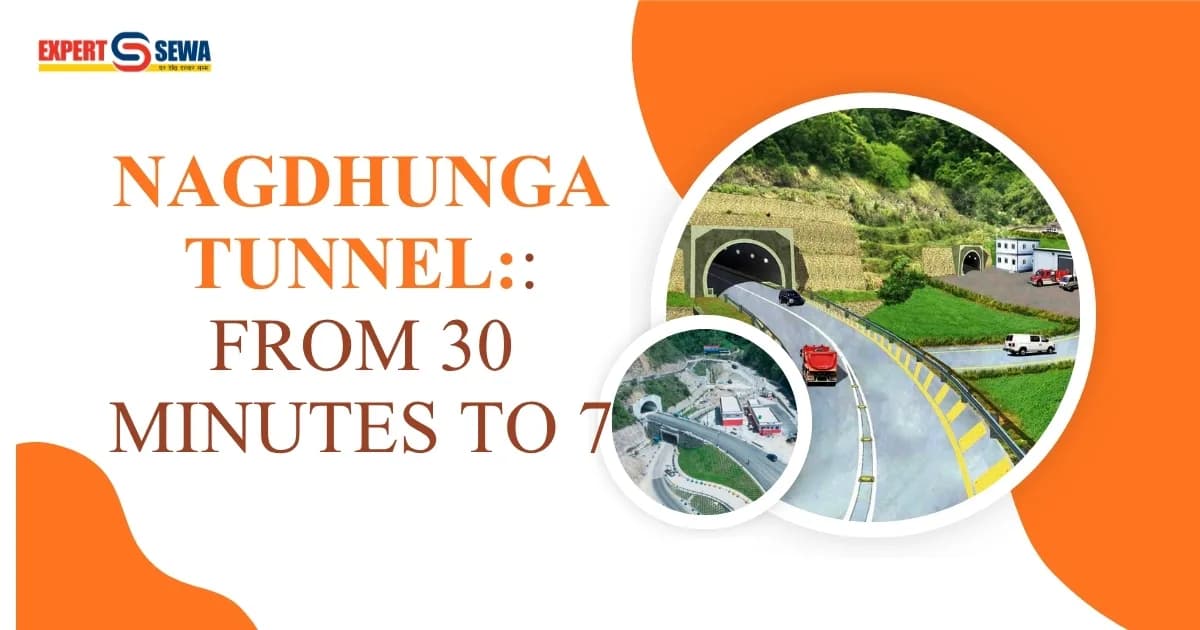
From 30 Minutes to 7: How the Nagdhunga Tunnel Changes Your Commute Forever
nagdhunga-tunnel-kathmandu-commute-guide
The Road That Broke Everyone's Patience
If you have ever driven through the Nagdhunga pass during morning rush hour, you already know the feeling. You leave your home in Thankot or Naubise at 7:30 AM, hopeful that today will be different. By 8:45 AM, you are still crawling uphill, engine overheating, truck fumes filling your car, and your phone buzzing with messages from your office asking where you are.
This is not an occasional bad day. For hundreds of thousands of Nepalis who travel between Kathmandu and western Nepal, this stretch of road has been a daily punishment for decades.
But something is finally changing.
The Nagdhunga Tunnel Nepal's first modern underground road tunnel is on the edge of transforming this experience completely. A journey that currently swallows 30 to 33 minutes of your life, stuck in traffic, pollution, and frustration, will soon take just 7 minutes through a 2.7-kilometre underground passage beneath the Nagdhunga hills.
This is not a rumour. This is real, it is almost here, and this article tells you everything you need to know about the Nagdhunga tunnel, its latest 2026 updates, what it means for your commute, and why it matters for Nepal's future.
What Exactly Is the Nagdhunga Tunnel?
The Nagdhunga tunnel, officially known as the Nagdhunga-Sisnekhola Tunnel Road, is an underground highway tunnel that connects Tutipakha near Balambhu on the Kathmandu side to Sisnekhola in Dhading district on the western side.
It is built directly beneath the historic Nagdhunga pass the same winding, steep, traffic-choked climb that has terrorised commuters, truck drivers, and tourists for generations.
Here are the core technical facts that matter:
Main Tunnel Length: 2,688 metres (approximately 2.7 km)
Emergency Evacuation Tunnel: 2,557 metres running parallel
Number of Lanes: 2 lanes (one in each direction)
Tunnel Height: 8.3 metres
Lane Width: 9.5 metres
Grade (slope inside): 3.5%
Total Project Cost: Approximately Rs 22 billion
Funded by: JICA (Japan International Cooperation Agency) Rs 16.5 billion concessional loan + Government of Nepal Rs 6 billion
Contractor: Japanese company Hazama Ando Corporation
Construction Started: October 21, 2019 The Nagdhunga road tunnel project is part of the Tribhuvan Highway network and represents the single most significant road infrastructure investment Nepal has made in recent memory.
Why Was This Tunnel Needed? The Real Problem on That Hill
To understand how important the Nagdhunga tunnel is, you need to understand just how broken the current road situation is.The Nagdhunga pass sits at roughly 2,122 metres above sea level. It is the western gateway into Kathmandu valley. Every single vehicle trucks carrying goods from Pokhara and beyond, buses full of passengers, private cars, ambulances, heavy machinery must crawl up or down this narrow, winding, steep road.
Here is what commuters deal with on a regular basis:
The Kathmandu traffic solution that people demanded for years was not more lanes on an impossible hillside. It was a tunnel through the hill itself. And that is exactly what the Nagdhunga tunnel delivers.
Buses and trucks block entire lanes while overtaking on sharp curves
During monsoon season, landslides close the road for hours or days
Accidents are frequent due to the steep gradient and narrow road width
Heavy vehicles cause road surface to deteriorate rapidly
Air pollution from diesel engines trapped in the valley of the pass is severe
Fuel consumption is massive due to idling and crawling in first gear
Emergency vehicles including ambulances get stuck behind the same traffic
The Big Number: From 33 Minutes to 7 Minutes
Let us be specific, because these numbers matter enormously in real life.
According to the official project data, the current average travel time from Sisnekhola to Balambhu via the Nagdhunga pass is:
Entering Kathmandu (uphill): 33 minutes
Exiting Kathmandu (downhill): 23 minutes
Once the Nagdhunga tunnel opens for full commercial operation, that same journey will take approximately 7 minutes in both directions, regardless of traffic.
That is a saving of 26 minutes entering and 16 minutes exiting Kathmandu, every single day, for every single vehicle.
Now multiply that across thousands of daily commuters, truck drivers, and travellers. The cumulative time saved across Nepal's transport network is staggering.
What Does 26 Minutes Mean in Real Life?
Consider Ramesh, a school teacher from Naubise who commutes to a private school in Balaju five days a week. Right now, he leaves home at 6:30 AM to reach school before the 8:00 AM bell. With the Nagdhunga tunnel, he can sleep an extra 25 minutes and still arrive on time. That is two and a half hours of sleep or personal time recovered every week.
Consider Sunita, who runs a small tailoring shop in Thankot but sources her fabric from Ason market in central Kathmandu. She currently avoids making return trips in the same day because the Nagdhunga climb adds so much time. After the tunnel opens, she can make two supply runs in the time she used to spend on one.
Consider the truck driver hauling fresh vegetables from Chitwan to Kalimati market. Every hour of delay on the Nagdhunga road means fresher produce arriving stale, higher fuel costs from idling engines, and missed early morning market prices. The Nagdhunga tunnel is not just about convenience it is about livelihoods.
Nagdhunga Tunnel Latest Update 2026: Where Does It Stand Right Now?
This is the question every Nepali has been asking. And honestly, the answer requires some patience because the Nagdhunga tunnel project has seen multiple deadline extensions.
Here is an honest, fact-based timeline of where things stand as of May 2026:
Milestone | Status |
Construction started | October 2019 |
Original completion target | April 2023 |
Main tunnel breakthrough | April 15, 2024 |
Evacuation tunnel breakthrough | August 2023 |
Physical construction progress | 98% complete |
Trial operation announced | Second week of May 2026 |
Expected commercial operation | Third week of July 2026 |
Toll fees approved | August 2025 (Cabinet approved) |
According to the April 17, 2026 statement from Project Chief and Joint Secretary Saujanya Nepal, the Nagdhunga tunnel is set to begin trial operation from the second week of May 2026, with full commercial operation expected from the third week of July 2026.
The delays that pushed back earlier deadlines (originally set for January 1, 2026, then the Nepali New Year of April 2026) were caused by:
1. Repeated landslides at the Dhading-side entrance requiring permanent reinforcement
2. Delays in selecting a private operator/service provider to manage the tunnel
3. Incomplete toll plazas at both ends
4. Japanese consultants requiring additional time for landslide protection systems
The good news is that as of May 2026, the technical handover process is underway, and the 90-day handover timeline points clearly toward July 2026 for full public use.
Toll Fees: What Will You Pay to Use the Nagdhunga Tunnel?
The Cabinet approved tunnel toll fees in August 2025. For the first two years of operation, the approved rates are:
Cars and vans: Rs 65 entering Kathmandu / Rs 60 exiting Kathmandu
Other vehicle categories have been set proportionally by the Nepal Road Board
These are among the most reasonable toll fees for the value delivered. When you factor in the fuel saved by not idling in Nagdhunga traffic, most regular commuters will actually save money on every trip even after paying the toll.
Important note: Pedestrians, motorcycles, three-wheelers, and non-motorised vehicles will not be permitted inside the tunnel for safety reasons. The Nagdhunga tunnel is designed for four-wheeled motor vehicles and above.
For Daily Commuters
Reliable, predictable travel time regardless of weather or season
Reduced stress from traffic congestion and dangerous overtaking
Lower vehicle wear and tear the gentle 3.5% tunnel grade versus the brutal Nagdhunga switchbacks
Significant fuel savings especially for trucks, buses, and heavy vehicles
For the Economy
Faster freight movement between Kathmandu and the western regions (Pokhara, Palpa, Butwal, Bhairahawa)
Reduced logistics costs for businesses across supply chains
Lower food prices in Kathmandu markets because transport costs drop
Increased economic activity in areas like Naubise, Dhading, and western Nepal that previously felt cut off by the traffic barrier
For Tourism
The Nagdhunga tunnel is a significant win for Nepal's tourism sector. Currently, travellers flying into Kathmandu and heading to Pokhara by road face the Nagdhunga delay as their first impression of Nepal's roads. A fast, modern tunnel changes that narrative immediately.
Trekkers heading to Annapurna, travellers visiting Lumbini, and business visitors going to the Terai will all experience a shorter, smoother entry and exit from Kathmandu valley. This is the kind of Nepal infrastructure development that makes international headlines and improves the country's image as a modern travel destination.
For the Environment
Counter-intuitively, the Nagdhunga tunnel is also a win for the environment even though it burns electricity to operate. Currently, thousands of vehicles idle in low gear on the Nagdhunga climb every day. Diesel trucks belching black smoke on a steep incline produce dramatically more emissions per kilometre than the same truck rolling smoothly at tunnel speed. The reduction in fuel burn and engine idling time will result in measurable decreases in CO2 and particulate emissions on this critical corridor.
Additionally, less traffic on the old Nagdhunga road means that historic route can be better maintained, possibly even restricted to lighter traffic or developed for tourism purposes.
Before vs After: The Nagdhunga Tunnel Comparison
Here is a clear comparison of what commuters experience before and after the tunnel opens:
Category | Before Tunnel | After Tunnel |
Travel Time (Entry to Kathmandu) | 30 to 33 minutes | 7 minutes |
Travel Time (Exit from Kathmandu) | 20 to 23 minutes | 7 minutes |
Fuel Cost per Trip (car) | High (idling + steep climb) | Significantly lower (flat tunnel) |
Traffic Congestion | Severe, especially mornings | Minimal inside tunnel |
Weather Disruptions | Frequent (landslides, fog) | None inside tunnel |
Accident Risk | High (narrow curves, overtaking) | Very low (controlled 2-lane road) |
Air Pollution Exposure | Very high (diesel fumes) | Managed (jet fans, ventilation) |
Predictability of Arrival | Unpredictable | Consistent |
Convenience for Heavy Vehicles | Extremely difficult | Much easier |
Monsoon Season Impact | Road often blocked | Tunnel unaffected |
Challenges the Project Faced: Nothing Worth Having Comes Easy
The Nagdhunga tunnel project did not have a smooth journey and that is worth acknowledging honestly. Construction began in October 2019, and almost immediately hit its first major obstacle: the COVID-19 pandemic. Work was halted for approximately 86 days during the first wave. Even after special permission was granted to resume during the second wave, progress slowed significantly as protecting workers on an underground construction site required additional protocols.
Beyond the pandemic, the project faced:
Geological surprises: The Nagdhunga hillside contains varied rock formations. Some sections required much more reinforcement than originally planned.
Landslides on the Dhading side: Repeated landslides during monsoon seasons disrupted work at the western entrance multiple times. This issue persisted into 2026 and required Japanese consultants to design permanent landslide protection systems.
Land acquisition disputes: Some local residents and landowners disputed compensation, causing legal delays.
Local protests: Community groups occasionally blocked work sites over various grievances, adding further delays.
Operator selection process: Finding a qualified private company to operate the tunnel proved more complicated than anticipated, pushing back the opening date multiple times.
Despite all of this, the project team persisted. The main tunnel breakthrough in April 2024 was a defining milestone the moment when two teams drilling from opposite ends finally met in the middle, 2,688 metres underground. That moment was celebrated as a major achievement for Nepal's construction sector and for the Japanese-Nepali technical partnership behind the project.
Public Reaction in Nepal: What People Are Saying
Walk into any tea shop in Kalanki, Thankot, or Naubise and ask about the Nagdhunga tunnel. You will get a mix of excitement, scepticism born from years of missed deadlines, and genuine hope.
A microbus driver who runs a daily route from Naubise to Ratna Park told reporters he has been waiting for this tunnel for his entire driving career. "If the tunnel opens, I can complete two extra return trips per day. That is real income for my family," he said.
A logistics company owner based in Balaju noted that his freight costs on the Kathmandu-Pokhara route are partly determined by how long trucks get stuck at Nagdhunga. "Even a 20-minute saving per truck, across 15 trucks per day, changes our monthly balance sheet significantly," he explained.
On social media platforms in Nepal, the Nagdhunga tunnel has become something of a running joke and a genuine point of national pride at the same time. Every missed deadline generates frustrated memes. But underneath the humour is a real desire to see Nepal deliver on its infrastructure ambitions.
The trial operation announcement for May 2026 has been received with cautious optimism. Most people say they will believe it when they drive through it themselves which is an entirely reasonable position given the history of delays.
Economic Impact: A Tunnel That Pays for Itself
The Rs 22 billion price tag sounds large. But consider the economic analysis. The Nepal highway project on this corridor carries an estimated 10,000 to 15,000 vehicles per day during peak periods, including private cars, public buses, microbuses, trucks, and heavy vehicles. At an average toll of Rs 60 per vehicle, daily toll revenue alone exceeds Rs 600,000 which over a year adds up to over Rs 200 million.
But the deeper economic impact is much larger than toll collection. Studies on similar tunnel projects in other countries show that reducing travel time on a key commercial corridor by 70 to 80 percent generates economic multiplier effects many times the construction cost over a 20 to 30 year period.
For Nepal's western corridor connecting Kathmandu to Pokhara, Butwal, Bhairahawa, and the Indian border faster, more reliable connectivity means:
Lower cost of goods reaching Kathmandu from western Nepal
More competitive exports from western Nepal reaching Kathmandu distribution hubs
Greater private investment in towns like Naubise, Dhading, and Malekhu
Stronger regional integration between Kathmandu and provinces 4 and 5
The Nagdhunga tunnel is, in a very real sense, an investment in the economic engine of the entire country's western half.
The Future of Tunnel Roads in Nepal
The Nagdhunga tunnel is just the beginning. Nepal's terrain dominated by steep Himalayan ridges, river gorges, and difficult topography is perfectly suited for tunnel-based infrastructure.
Several other tunnel road projects are in various stages of planning and development:
Siddhababa Tunnel (Palpa-Syangja corridor) aimed at reducing travel time on the Siddhartha Highway
Nagdhunga to Tribhuvan Highway upgrades continuing beyond the tunnel
Various tunnel proposals for Kali Gandaki corridor and other sections of the Postal Highway
The success or failure of the Nagdhunga tunnel will set the template for all future Nepal tunnel projects. It will shape how the government structures contracts, selects operators, manages communities, and handles construction in difficult mountain terrain.
If the Nagdhunga tunnel operates smoothly which all technical indicators suggest it will it will prove to investors, development banks, and international partners that Nepal can build and manage world-class transport infrastructure. That confidence has value beyond any single project.
Nepal transport development is at a turning point. The Nagdhunga tunnel is the proof of concept the country needed.
FAQ: Your Top Questions About the Nagdhunga Tunnel, Answered
1. When will the Nagdhunga tunnel open for public use?
As of May 2026, trial operation is expected from the second week of May 2026, with full commercial operation targeted for the third week of July 2026. However, given past delays, it is advisable to watch for official announcements from the Department of Roads.
2. How long is the Nagdhunga tunnel?
The main Nagdhunga tunnel is 2,688 metres long (approximately 2.7 km). There is also a parallel emergency evacuation tunnel measuring 2,557 metres.
3. How much does it cost to use the Nagdhunga tunnel?
Cars and vans will pay Rs 65 entering Kathmandu and Rs 60 exiting Kathmandu. These toll rates are approved for the first two years of operation.
4. Can motorcycles use the Nagdhunga tunnel?
No. Motorcycles, three-wheelers, pedestrians, cyclists, and non-motorised vehicles are not permitted inside the Nagdhunga tunnel due to safety regulations.
5. How long does the tunnel journey take?
The journey through the Nagdhunga tunnel takes approximately 7 minutes, compared to 30 to 33 minutes on the current Nagdhunga pass road.
6. Who built the Nagdhunga tunnel?
The Nagdhunga tunnel was built by Japanese construction company Hazama Ando Corporation, funded through a JICA concessional loan of approximately Rs 16.5 billion and a Government of Nepal contribution of Rs 6 billion, totalling Rs 22 billion.
7. Is the Nagdhunga tunnel safe?
Yes. The tunnel is equipped with jet fans for ventilation, CCTV cameras throughout, emergency lighting, cross passages connecting the main tunnel to the evacuation tunnel, and a dedicated emergency evacuation tunnel running parallel to the main road.
8. Will the Nagdhunga tunnel reduce Kathmandu traffic?
Significantly, yes. The Nagdhunga tunnel will remove one of Kathmandu valley's worst bottlenecks. Traffic on the existing Nagdhunga pass road is expected to drop dramatically once the tunnel opens, easing congestion not just on the hill but also at Kalanki and Balaju intersections.
9. What is the Nagdhunga tunnel's effect on travel time from Kathmandu to Pokhara?
While the tunnel itself covers only 2.7 km, it eliminates the slowest and most congested section of the Kathmandu-Pokhara road. Combined with other highway improvements, the overall Kathmandu to Pokhara journey time is expected to decrease noticeably.
10. Why did the Nagdhunga tunnel get delayed so many times?
Multiple factors caused delays: COVID-19 pandemic (86-day construction halt), repeated landslides at the Dhading entrance, complex geological conditions requiring extra reinforcement, slow land acquisition in some areas, and a time-consuming process to select a private operator for the tunnel.
11. Is this Nepal's first road tunnel?
Yes. The Nagdhunga-Sisnekhola tunnel is Nepal's first modern underground road tunnel. It represents a landmark milestone in Nepal's transport and infrastructure history.
12. What vehicles are allowed in the Nagdhunga tunnel?
All four-wheeled motor vehicles and above are permitted including private cars, vans, buses, minibuses, trucks, and heavy vehicles. Two-wheelers and three-wheelers are not allowed.
Conclusion: Nepal Is Moving Forward, One Tunnel at a Time
There is something deeply symbolic about a tunnel. You enter from one side in darkness, unsure what the road ahead holds. And then, after a few moments, light appears at the other end and the world on the other side is faster, cleaner, and better connected than the one you left behind.That is exactly what the Nagdhunga tunnel represents for Nepal. For decades, Nepalis heading west from Kathmandu whether they were students travelling home for Dashain, families rushing a loved one to hospital, truck drivers delivering food to mountain markets, or tourists eager to reach Pokhara all faced the same brutal climb at Nagdhunga. It was the price of geography. It seemed immovable.
The Nagdhunga tunnel is proof that it was not immovable. It just required vision, investment, engineering skill, and yes patience. With trial operations expected in May 2026 and full commercial operation targeted for July 2026, that light at the end of the tunnel has never been closer for Nepal's western corridor. This is what Nepal infrastructure development looks like when it arrives not with noise, but with seven quiet minutes through solid rock.
The next time you leave Kathmandu heading west, you may find yourself choosing between the old winding road up Nagdhunga hill and a modern 2.7-kilometre tunnel beneath it. That choice itself unimaginable just a few years ago is the story of Nepal's progress. The road ahead is shorter than you think.
This article is based on verified reports from the Kathmandu Post, My Republica, the Department of Roads Nepal, and JICA Nepal. All figures and dates reflect information available as of May 2026. For the most current Nagdhunga tunnel latest update, follow official announcements from the Ministry of Physical Infrastructure and Transport.