
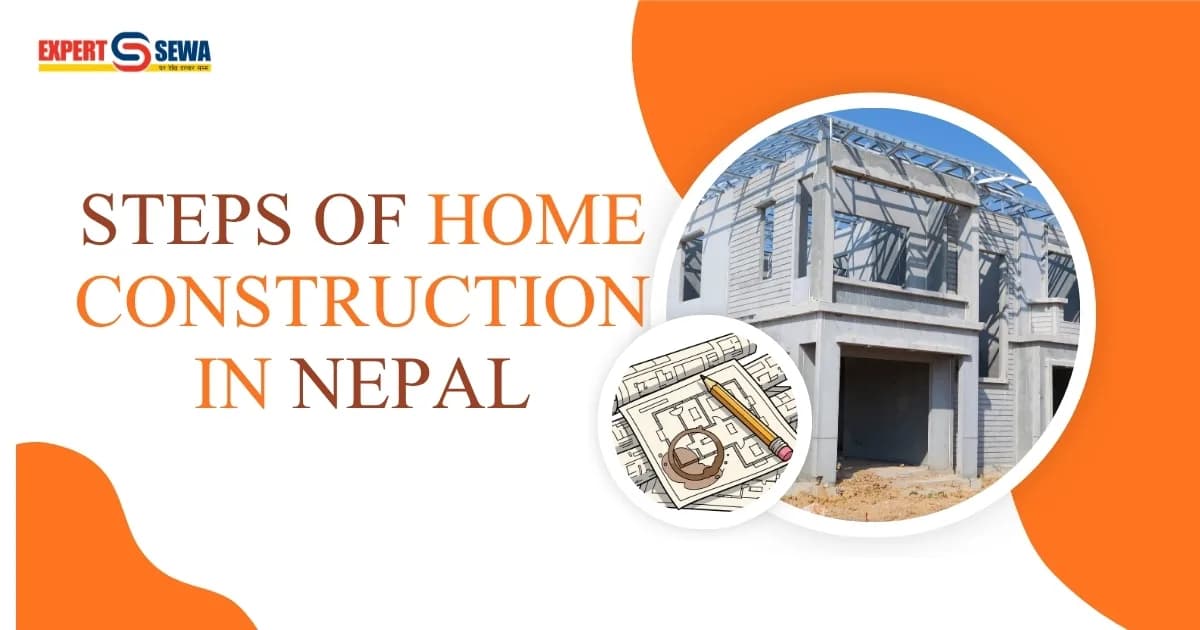
Steps of Home Construction in Nepal: A Complete Guidebook for Building a House in Nepal
Introduction
Building your own home is one of the most significant milestones in a Nepali person's life. Whether you are a government employee saving for years, a foreign employment returnee investing hard-earned remittance, or a young professional buying land in Kathmandu or Pokhara — the dream of owning a house in Nepal is deeply personal and emotionally powerful.
But let's be honest: home construction in Nepal is not simple. Between navigating municipality approvals, dealing with unpredictable material prices, finding trustworthy contractors, and managing daily construction headaches — many people feel overwhelmed before even laying the foundation.
This guide is written exactly for you. Whether you are building for the first time or planning to rebuild an older structure, this complete guidebook covers every major step of home construction in Nepal in a practical, no-nonsense way. No fluff. No jargon. Just real, grounded advice from a civil engineering perspective tailored for Nepali ground realities.
Why Planning Matters Before You Start Building
Many Nepali homeowners make the mistake of rushing into construction without a solid plan. They buy land, hire a mason, and start digging — only to realize midway that the design doesn't fit the land properly, the budget has been exhausted, or the municipality is asking for documents they never prepared.
Proper planning before construction helps you:
Save 15–25% of your total construction cost by avoiding expensive rework
Ensure your structure is earthquake-resistant and legally compliant
Avoid disputes with neighbors, contractors, and government bodies
Complete construction on time and within budget
Nepal sits in one of the world's most seismically active zones. The 2015 Gorkha Earthquake taught every Nepali the hard truth — poorly planned and constructed homes cost lives. Planning isn't just about money. It's about safety.
Step-by-Step Home Construction Process in Nepal
Step 1: Land Selection and Legal Verification
Before anything else, you need to be absolutely sure about the land you are building on. This is where many buyers make costly mistakes.
Things to verify:
Lalpurja (Ownership Certificate): Confirm the land is registered in the seller's name at the Land Revenue Office (Malpot Karyalay)
Tiro-Tirna: Check that all land taxes are paid and up to date
Boundary Demarcation: Get the land measured officially by a licensed surveyor (Napi) to avoid future boundary disputes
Land Use Zoning: Check whether the land falls under residential, agricultural, or commercial zone. Building a house on agricultural land (Krishi Bhoomi) requires conversion (Raikar conversion) before construction
Access Road: Ensure there is legal road access to the plot. Without a road, municipalities will not issue a building permit
Real Example: Many people purchase land in the outskirts of Kathmandu Valley — areas like Bhaktapur, Budhanilkantha, or Banepa — only to discover it's still under agricultural zoning. Converting the land category adds 3–6 months and additional cost. Always check zoning before buying.
Step 2: Soil Testing and Site Analysis
Once your land is legally cleared, the next critical step is soil testing (Soil Investigation or Geotechnical Investigation). This is often skipped by cost-conscious builders — and it's one of the most dangerous shortcuts you can take.
Soil testing helps determine:
Bearing capacity of the soil (how much load it can safely support)
Presence of loose, waterlogged, or expansive soil
Depth at which stable soil or rock is found (determines foundation depth)
Whether the site is prone to liquefaction during earthquakes
In Nepal, soil testing typically costs between NPR 15,000 to NPR 50,000 depending on the depth and number of boreholes. This is a small price compared to what a foundation failure costs.
Step 3: House Design and Architectural Planning
This is the exciting part — but also the part that requires the most careful thought.
In Nepal, house design must balance several factors:
Number of floors and future expansion plans
Vastu Shastra preferences (many Nepali families still follow this)
Sunlight and ventilation — especially important in hilly terrain
Earthquake resistance — mandatory in Nepal under NBC (Nepal Building Code)
Budget constraints
You have two main options for house design in Nepal:
Licensed Architect or Civil Engineer: Recommended for all permanent structures. They prepare detailed architectural drawings, structural drawings, and construction documents. Cost: NPR 30,000 – NPR 1,50,000+ depending on house size and complexity.
Ready-Made or Modified Designs: Some municipalities and engineering firms offer standard designs. These are cheaper but may not perfectly fit your plot.
Pro Tip: Always insist on a structural drawing in addition to architectural drawings. Many people only get a floor plan but skip the beam-column-slab structural design — this is a serious safety risk.
Step 4: Municipality Approval — Building Permit Process in Nepal
This is the legal backbone of your construction project. Building without a permit in Nepal is illegal and can result in demolition orders, heavy fines, or inability to sell/mortgage your property later.
General Process for Building Permit in Nepal:
Submit application to your local Palika (Municipality/Rural Municipality)
Required documents typically include:
Land ownership certificate (Lalpurja)
Survey map (Napi Naksha)
Architectural and structural drawings (by licensed engineer/architect)
Site plan showing setbacks
Engineer/Architect's seal and signature
Tax clearance certificate
Municipality reviews the application and drawings
Site inspection may be conducted
Building permit is issued (usually within 15–45 days)
Key Rules to Know:
Setback rules: Minimum distance from road and neighbors must be maintained (varies by road width and municipality)
Floor Area Ratio (FAR): Limits total buildable floor area relative to plot size
Building Height Restrictions: Especially in Kathmandu Valley and near airports
Compliance with NBC 205 (Mandatory Rules of Thumb for Reinforced Concrete Buildings)
In Kathmandu Metropolitan City, building permit fees are calculated based on built-up area. For a standard 3-storey residential building, permit fees can range from NPR 20,000 to NPR 80,000.
Step 5: Cost Estimation and Budgeting
Before breaking ground, prepare a realistic construction budget. Many Nepali builders start construction with an estimated cost but end up spending 20–40% more due to poor planning.
A Bill of Quantities (BOQ) prepared by your engineer will give you a detailed material and labor cost breakdown. This document is your financial roadmap.
Always include a contingency reserve of 10–15% for unexpected expenses — material price changes, design modifications, or site challenges.
Step 6: Hiring a Contractor vs. Daily Labor (Theka vs. Dailey)
This is one of the most debated topics among Nepali homeowners.
Factor | Contractor (Theka) | Daily Labor (Dailey) |
Cost | Fixed price, easier to budget | Potentially cheaper but unpredictable |
Accountability | Contractor is responsible for quality | Owner must supervise closely |
Speed | Usually faster completion | Can be slow without proper management |
Risk | Low if contract is well-written | Higher — relies on owner's daily oversight |
Best For | Full construction, busy owners | Small works, owners who can supervise daily |
Recommendation: For a full home construction project, hiring a registered contractor with a written contract is the safer choice. Include penalty clauses for delays and quality specifications in the contract.
Step 7: Foundation Work
The foundation is literally what your home stands on. In Nepal, the most common foundation types are:
Isolated Footing (Column Footing): Used for RCC structures. Most common in urban Nepal.
Strip Footing: Used for load-bearing masonry walls
Raft/Mat Foundation: For weak or waterlogged soil (increasingly used in Terai)
Foundation depth depends on soil test results. In most of the Kathmandu Valley, foundations are dug 1.2m to 2m deep before reaching stable soil.
Critical step during foundation: Get your engineer on-site during concrete pouring. The foundation concrete mix, reinforcement placement, and curing are non-negotiable quality checkpoints.
Step 8: RCC Structure Construction
RCC (Reinforced Cement Concrete) construction is the dominant construction method in urban Nepal. It involves constructing columns, beams, and slabs using concrete and steel reinforcement bars (rebars).
Key stages of RCC construction:
Column construction (ground floor to top)
Beam and slab shuttering
Steel reinforcement placement (checked against structural drawings)
Concrete mixing and pouring (use controlled water-cement ratio)
Curing — keeping concrete moist for minimum 7–14 days (critical for strength)
Shuttering removal (not before 21 days for slabs)
Common Mistake in Nepal: Using excess water in concrete for easier mixing. This reduces concrete strength significantly. Always follow the design mix ratio specified by your engineer.
The most used concrete grade for residential RCC in Nepal is M20 (1:1.5:3 ratio) for columns/beams and M15 (1:2:4) for plain concrete work.
Step 9: Brickwork and Plastering
Once the RCC frame is complete, brick walls are built between columns.
Common brick options in Nepal:
Traditional fired bricks (Ita): Most common, good thermal mass, moderate strength
Hollow Concrete Blocks: Cheaper, faster, good for upper floors
AAC (Autoclaved Aerated Concrete) Blocks: Lightweight, excellent insulation, growing in popularity in Kathmandu
For plastering, a 12mm–15mm thick cement-sand plaster (ratio 1:4 or 1:6) is standard. Apply in two coats for a smooth finish.
Step 10: Electrical and Plumbing Work
Electrical work should be done by a licensed electrician following Nepal Electricity Authority (NEA) guidelines. Common elements include:
Internal wiring (conduit wiring is standard)
Distribution board (DB) installation
Light and fan points, power sockets
Earthing and safety devices (MCBs, RCCBs)
Plumbing work covers:
Water supply lines (CPVC or PPR pipes recommended)
Drainage and sewer lines (PVC pipes)
Bathroom and kitchen fixtures
Underground water tank and overhead tank sizing
Always plan electrical and plumbing layouts before plastering — it is far cheaper to embed conduits and pipes in walls before finishing than to break walls later.
Step 11: Roofing and Finishing
Roofing options in Nepal:
RCC Roof Slab: Most common in urban areas, durable, can be used as terrace
CGI Sheet Roofing: Common in hills and rural areas, economical
Clay Tile Roofing: Traditional Newari style, beautiful but expensive
Bituminous Waterproofing: Applied on RCC roofs to prevent leakage (essential in Nepal's monsoon climate)
Finishing work includes:
Floor tiling (vitrified tiles, ceramic, stone)
Door and window frames and shutters
Ceiling work (POP, false ceiling, or exposed concrete)
Paint and wall texture
Step 12: Interior and Exterior Design
The final touch that transforms a building into a home. Interior design in Nepal has evolved rapidly, with many homeowners now opting for:
Modular kitchen designs
Built-in wardrobes
Accent walls and textured paint finishes
Landscaping and boundary walls with gates
For exterior design, popular choices include exposed brick facades, stone cladding, and modern concrete finishes — all of which perform well in Nepal's climate.
Estimated Cost of Building a House in Nepal (2026 Update)
Costs vary significantly based on location, materials, and finishing level. Here is a practical breakdown:
Construction Cost Per Square Foot (2026 Estimates)
Construction Type | Cost per Sq. Ft. (NPR) |
Low-cost / Basic | NPR 2,500 – 3,500 |
Medium Standard | NPR 3,500 – 5,500 |
High-end / Luxury | NPR 5,500 – 9,000+ |
Note: Kathmandu Valley costs are typically 15–20% higher than other cities like Pokhara, Chitwan, or Butwal.
Rough Material vs. Labor Cost Split
Cost Component | Approximate Share |
Construction Materials | 55–65% |
Labor Costs | 25–35% |
Engineer/Design/Permit Fees | 5–8% |
Contingency/Miscellaneous | 5–10% |
Important Tips for Nepali Home Builders
How to Save Cost
Buy construction materials in bulk during off-season (winter months) when prices dip
Use AAC blocks for upper floors — they reduce structural load and labor time
Avoid over-designing — unnecessary decorative columns or extra slab projections add cost without value
Supervise your construction daily or hire a site engineer — prevents material theft and ensures quality
Mistakes to Avoid
Skipping soil testing to save money
Not getting a proper written contract with your contractor
Making frequent design changes mid-construction (change orders are budget killers)
Using sub-standard TMT bars or cement — never compromise on structural materials
Ignoring waterproofing — roof and bathroom leaks are Nepal's most common and costly post-construction complaints
Choosing Quality Materials
Use 43-grade or 53-grade OPC cement for structural work
For steel, use Fe500D TMT bars from reputed brands (Himal, Panchakanya, Jagadamba)
Use good quality bricks — tap a brick; it should produce a clear ringing sound
For plumbing, prefer PPR or CPVC pipes over old PVC for hot water lines
Legal and Government Requirements in Nepal
Nepal Building Code (NBC)
Nepal adopted the Nepal Building Code to ensure structural safety, especially earthquake resistance. The most relevant code for residential buildings is NBC 205 — mandatory rules for RCC buildings without a detailed structural design.
Municipality Rules
Each local government (Palika) has its own building bylaws. General rules include:
Road setback: Minimum 1.2m to 3m from road edge depending on road width
Side setback: Minimum 1m from neighbor's boundary in most urban areas
Height limit: Generally 8.23m (two-and-a-half storeys) for standard residential plots
Building completion certificate: Must be obtained after construction for legal occupancy
Failure to comply can mean your building is declared illegal, making it difficult to get bank loans, sell the property, or even get electricity and water connections.
Low-Cost House Construction Tips in Nepal
Building affordable doesn't mean building poorly. Here's how smart Nepali builders reduce costs without sacrificing quality:
Keep the floor plan simple and rectangular — complex shapes require more material and labor
Reduce floor-to-floor height to the minimum comfortable level (10 feet is standard; dropping to 9.5 feet saves significant concrete and masonry)
Use locally sourced stone for foundation and retaining walls instead of expensive brickwork
Consider a two-phase construction plan — build one floor now, add the second later
Do your own supervision rather than hiring a full-time site engineer if you have the time and basic knowledge
Explore government subsidy programs for earthquake-resistant housing in rural areas (NRA programs post-2015 earthquake)
Conclusion
Building a house in Nepal is a journey — sometimes stressful, often exciting, and ultimately deeply rewarding. From finding the right land to plastering the final wall, every step requires attention, knowledge, and patience.
The key takeaways from this complete guidebook are simple:
Plan thoroughly before you build — every rupee spent on planning saves five during construction
Never skip legal requirements — building permits and NBC compliance are non-negotiable
Invest in quality structural materials — you can save on aesthetics, but never on safety
Work with licensed professionals — architects, engineers, and registered contractors are your best allies
Budget with a contingency buffer — Nepal's construction market is dynamic, and prices move
Your home is not just a building. It's where your family grows, where memories are made, and where safety matters most. Build it right.
Frequently Asked Questions (FAQs)
Q1: How long does it take to build a house in Nepal?
For a standard 2–3 storey residential building, construction typically takes 12 to 24 months depending on size, budget availability, weather, and contractor efficiency. Proper planning and uninterrupted funding can reduce this significantly.
Q2: What is the average cost of building a house in Nepal in 2026?
For a medium-standard 3-storey house of approximately 1,000 sq. ft. per floor, the total construction cost typically ranges from NPR 45 lakh to NPR 80 lakh in Kathmandu. Costs vary by location, design complexity, and finishing quality.
Q3: Is a building permit mandatory in Nepal?
Yes, absolutely. Under Nepal's local government building bylaws, constructing any permanent structure without a building permit is illegal. Unpermitted buildings face risks of demolition orders and cannot be legally sold or mortgaged.
Q4: Can I build a house on agricultural land in Nepal?
You must first convert (Raikarization) agricultural land to residential use through the Land Revenue Office and relevant government bodies before applying for a building permit. Building on unconverted agricultural land is not permitted.
Q5: What is the most earthquake-safe construction method for homes in Nepal?
RCC (Reinforced Cement Concrete) frame construction designed according to Nepal Building Code (NBC) is currently the most earthquake-resistant method for permanent homes in Nepal. Ensure your structural design is done by a licensed civil engineer and NBC 205 guidelines are strictly followed during construction.
Need Expert Help With Your Home Construction in Nepal?
Building a home is a once-in-a-lifetime investment — and you deserve the right team by your side.
Expert Sewa connects Nepali homeowners with verified civil engineers, licensed architects, experienced contractors, and construction supervisors across Nepal. Whether you need a house design, structural drawings, building permit assistance, or full construction management — we've got you covered.
📞 Contact Expert Sewa today and get a free initial consultation for your home construction project. Build smart. Build safe. Build with confidence.
This article was written from a civil engineering perspective for informational purposes. Always consult a licensed engineer or architect for site-specific professional advice.