
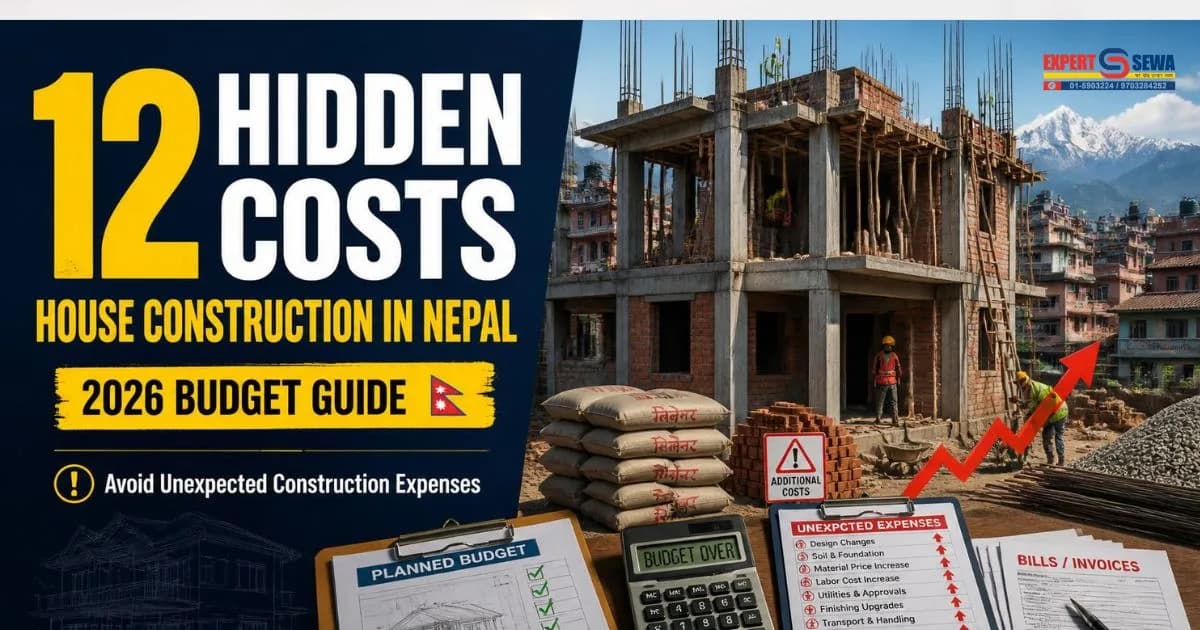
The Reality of the Headline Construction Rate in Nepal
Homeowners constructing residential properties across Kathmandu, Pokhara, or the Terai often start with a familiar headline estimate: NPR 3,200 per sq. ft. for a standard 2.5-storey RCC frame building measuring 2,000 sq. ft.
This results in an initial estimated budget of NPR 6,400,000 (based on 2,000 sq. ft. at NPR 3,200 per sq. ft.).
However, within six months of work, unexpected ground conditions, local municipal clearance costs, manual material transportation, perimeter fencing, and water storage setups frequently drive overall expenses beyond NPR 9.2 million—representing a major 44% budget expansion.
The primary reason is that conventional contractor quotes in Nepal strictly encompass the core structural frame within the building plinth footprint. Essential items like site logistics, regulatory permits, external utility networks, and upgraded interior finishes are routinely left out. Recognizing these hidden construction expenses is crucial for protecting your financial plan.
6 Operational Categories of Unexpected Costs
1. Subsurface & Structural Adjustments: Soil testing, raft/strap foundations, plum concrete, and RCC retaining walls.
2. Statutory & Engineering Fees: Digital Building Permit System (DBSA/Naksa Pass) fees, structural vetting, and completion certificates (Nirman Sampanna).
3. Logistics & Material Carriage: Secondary tractor shuttles and manual head-load carrying (kholi/bokai) along narrow access roads .
4. Independent Wet Utilities: Cast-in-place RCC underground water sumps, overhead tanks, septic tanks, and soak pits.
5. Electrical & Service Infrastructure: Nepal Electricity Authority (NEA) 3-phase meter connections, heavy appliance wiring, and chemical earthing.
6. Compound Development & Finishing Variance: Perimeter walls, steel gates, compound pavers, and the spread between standard contractor allowances and premium material selections.
12 Hidden Costs of House Construction in Nepal
1. Soil Testing & Subsurface Realities
What It Is: Geotechnical borehole drilling, core sampling, and Standard Penetration Tests (SPT) to determine Safe Bearing Capacity (SBC) under the Nepal National Building Code (NBC 105:2020).
Budget Impact: NPR 25,000 – NPR 60,000 for standard testing. If poor soil requires switching from isolated footings to a mat/raft foundation or soil replacement, structural costs rise by NPR 250,000 – NPR 700,000+.
Mitigation: Commission an independent soil test before finalizing structural drawings.
2. Foundation Depth & Retaining Walls
What It Is: Additional excavation, boulder soling, plum concrete, and RCC retaining barriers on sloped plots or low-lying agricultural land (khet land).
Budget Impact: Adding 1–2 feet of footing depth costs NPR 50,000 – NPR 120,000. Constructing an RCC cantilever retaining wall can add NPR 300,000 – NPR 900,000.
Mitigation: Conduct a topographical contour survey and specify unit rates for extra earthwork in the Bill of Quantities (BOQ).
3. Design Changes & Variations During Execution
What It Is: Post-commencement modifications to floor plans, door/window openings, bathroom locations, or structural columns.
Budget Impact: NPR 0 at the CAD stage, but structural chipping and sanitary modifications during construction add NPR 150,000 – NPR 500,000+.
Mitigation: Freeze 2D layouts and MEP plans before plinth casting; mandate written Variation Orders.
Construction Stage | Cost Impact of Changes | Primary Cause |
Planning Stage | NPR 0 | CAD redraws |
RCC Frame Stage | NPR 50,000 – NPR 150,000 | Chipping, beam/column rework |
Brickwork Stage | NPR 150,000 – NPR 300,000 | Wall demolition & reconstruction |
Finishing Stage | NPR 300,000 – NPR 600,000+ | Damaged concealed pipes & tiles |
4. Municipal Permits, Taxes & Professional Engineering Fees
What It Is: Statutory fees for the Digital Building Permit System (DBSA/Naksa Pass), municipal structural vetting, designer consultation, and the final Nirman Sampanna certificate.
Budget Impact: Architectural/MEP design fees (NPR 60,000 – NPR 180,000) plus municipal scrutiny and security deposits (NPR 70,000 – NPR 200,000) total NPR 130,000 – NPR 380,000.
Mitigation: Verify municipal tax schedules and account for security deposits (Dharauti) as locked capital.
5. Narrow Road Logistics & Secondary Haulage
What It Is: Secondary transport via power-tillers or mini-tractors and manual head-load carrying (kholi/bokai) when access roads are under 10–12 feet.
Budget Impact: Adds NPR 140,000 – NPR 370,000+ in secondary haulage and manual labor surcharges over the course of the project.
Mitigation: Define procurement terms as "F.O.R. Site Unloaded at Plinth" rather than "F.O.R. Roadside."
6. Material Price Escalation & Contract Clauses
What It Is: Mid-project market price surges in Fe 500D TMT rebar, 53/43-grade cement (OPC/PPC), river sand, and machine-made bricks over a 9- to 18-month build.
Budget Impact: A price increase of NPR 10/kg for rebar and NPR 80/bag for cement adds NPR 150,000 – NPR 220,000 to a standard 2,000 sq. ft. build.
Mitigation: Define a baseline material price appendix in your contract and pre-purchase structural steel in bulk.
7. Electrical Layout Upgrades & Utility Connections
What It Is: Upgrading from basic builder provisions (1 light, 1 single socket per room) to dedicated 16A lines for ACs, geysers, induction cooktops, EV chargers, and NEA 3-phase meters.
Budget Impact: NPR 120,000 – NPR 300,000 for high-load distribution boards, RCBO breakers, and chemical earthing pits.
Mitigation: Finalize a complete furniture and electrical point schedule prior to brick wall chasing.
8. Water Storage, Septic Systems & Site Drainage
What It Is: Essential external wet infrastructure, including cast-in-place RCC underground water tanks, septic tanks, and soak pits.
Budget Impact: NPR 330,000 – NPR 620,000 total:
12,000L RCC Underground Sump: NPR 180,000 – NPR 320,000
Double-Chamber Septic Tank & Soak Pit: NPR 100,000 – NPR 180,000
Pressure pump and municipal hookups: NPR 50,000 – NPR 120,000
Mitigation: Include underground tanks and sanitation systems directly in the primary structural BOQ.
9. Specialized Waterproofing Systems
What It Is: Elastomeric coatings, crystalline waterproofing admixtures, and polymer-modified sealants applied to roof terraces, sunken bathroom slabs, and foundation DPC layers.
Budget Impact: Preventative treatment costs NPR 70,000 – NPR 160,000. Retroactive remediation after leaks occur costs 3x to 4x more.
Mitigation: Require integral waterproofing admixtures in all slab casting and conduct a mandatory 48-hour flood ponding test before laying tiles.
10. Boundary Walls, Gates & Compound Works
What It Is: External plot development, including brick boundary walls with RCC tie-columns, metal sliding/swing gates, compound paving, and storm drainage.
Budget Impact: NPR 400,000 – NPR 830,000 for 150 linear feet of boundary wall, gate fabrication, and interlocking concrete pavers.
Mitigation: Treat compound development as an itemized external civil works package with defined footing depths.
11. Interior Finishing & Fixture Allowances
What It Is: The price gap between basic contract provisional sums and homeowner selections for vitrified tiles, sanitaryware, modular kitchens, and seasoned hardwood doors.
Budget Impact: NPR 400,000 – NPR 1,200,000+ over baseline allowances.
Mitigation: Attach an itemized Material Specification Schedule with precise per-unit price baselines (e.g., NPR 180/sq. ft. for tiles) to the contract.
12. Site Contingency & Weather Disruptions
What It Is: Liquid capital reserved to absorb monsoon delays, site anomalies, municipal utility trenching, and minor scope variations.
Budget Impact: An unallocated cash reserve equal to 8% to 10% of the total project value (NPR 500,000 – NPR 900,000).
Mitigation: Keep this reserve in a separate liquid bank account under direct owner control; do not disburse it to the builder up front.
2,000 Sq. Ft. Residential Budget Model (2.5 Storey RCC Frame)
Project Cost Component | Baseline Quote (NPR) | Realistic Move-In Scope (NPR) | Variance & Budget Explanation |
Core Civil & Finishing Structure | 6,400,000 | 6,400,000 | 2,000 sq. ft. @ NPR 3,200/sq. ft. base rate. |
Soil Testing & Structural Design | Excluded | 45,000 | Borehole drilling, SPT, geotechnical analysis. |
Permits & Engineering Fees | Excluded | 180,000 | DBSA submission, drawings, municipal tax. |
Foundation Adjustments & Soling | Excluded | 220,000 | Deep excavation, stone soling, plum concrete. |
Narrow Road Transport & Bokai | Excluded | 160,000 | Tractor shuttle and manual head-load carrying. |
12,000L Underground RCC Tank | Excluded | 240,000 | Waterproofed RCC sump with cover slab. |
Septic Tank & Soak Pit | Excluded | 130,000 | Double-chamber brick unit and soak pit. |
Boundary Wall, Gate & Pavers | Excluded | 480,000 | 140 linear ft wall, steel gate, compound paving. |
Electrical Upgrades & NEA Meter | Excluded | 160,000 | Dedicated 16A lines, earthing pit, 3-phase meter. |
Chemical Waterproofing | Excluded | 95,000 | Crystalline/elastomeric systems + flood tests. |
Finishing & Fixture Upgrades | Basic Only | 450,000 | Vitrified tiles, branded CP brass fittings, granite. |
Contingency Reserve (8%) | Excluded | 680,000 | Unallocated safety buffer for site emergencies. |
Total Estimated Commitment | NPR 6,400,000 | NPR 9,240,000 | Variance: +44.4% Over Headline Quote |
Comprehensive Contractor Quotation Checklist
Before signing a contract or transferring an advance, verify these six technical checkpoints:
1. Subsurface Assumptions: Assumed Safe Bearing Capacity (SBC) stated in writing; unit rates fixed for deep excavation and boulder soling.
2. Material Specifications: Specified concrete mix grades (M20/M25), TMT rebar brands (Fe 500D), and cement types (OPC for frame, PPC for masonry).
3. External Infrastructure: Explicit dimensions and specifications for the underground water tank, septic tank, and perimeter wall.
4. Services & Utilities: Total electrical point counts, copper wire gauges, conduit brands, and plumbing pressure ratings (CPVC/PPR).
5. Finishing Baselines: Clear NPR per-square-foot allowances for floor tiles, wall cladding, kitchen granite, and door frames (chaukhat).
6. Logistics & Delivery: Explicit "F.O.R. Site Plinth" delivery terms covering all secondary handling and manual carrying.
Construction Management for Non-Resident Nepalis (NRNs)
Retain an Independent Civil Engineer: Hire a third-party, Nepal Engineering Council (NEC)-registered consulting engineer to verify reinforcement binding, cover blocks, and concrete slump before major slab pours.
Require Digital Progress Tracking: Mandate weekly high-resolution, geo-tagged photos, 360-degree walkthrough videos, and lab concrete cube crush test reports.
Enforce Zero-Oral-Variation Rules: Require digital sign-off on standardized Variation Order Forms with fixed NPR adjustments before changes proceed on site.
Maintain a Digital Measurement Book (MB): Base item-rate settlements strictly on verified, jointly signed site measurements.
10 Non-Negotiable Rules of Construction Budget Control
1. Freeze Drawings Early: Complete all architectural, structural, and MEP drawings prior to ground excavation.
2. Reject Single-Page Estimates: Insist on an itemized Bill of Quantities (BOQ) with defined line-item rates.
3. Itemize Exclusions: Clearly define excluded items (water tank, boundary wall, municipal fees) in writing.
4. Compare Identical Specifications: Evaluate competing bids using identical material grades, steel brands, and fixture allowances.
5. Pre-Agree on Variation Rates: Lock unit rates for extra earthwork, masonry, and concrete in the contract.
6. Set Precise Finishing Allowances: Define exact unit rates for tiles, sanitary sets, and woodwork.
7. Separate External Works: Budget the main building, boundary walls, and water infrastructure as distinct project modules.
8. Invest in Concealed Materials: Prioritize high-grade internal plumbing, wiring, and waterproofing chemicals over superficial decor.
9. Hold a 5% to 10% Retention Fund: Retain a defect liability buffer for 6 to 12 months after handover until the building weathers a full monsoon season.
10. Maintain a 10% Liquid Buffer: Keep an independent contingency reserve under your direct control throughout the build.
Frequently Asked Questions
What are the primary hidden costs of building a house in Nepal?
The major overlooked expenses are geotechnical soil tests, municipal building permits (DBSA), narrow-access secondary transport (bokai), underground RCC water sumps, septic systems, boundary walls, chemical waterproofing, electrical upgrades, and premium finishing spreads over standard allowances.
Why does residential construction in Nepal exceed initial estimates?
Most headline quotes cover only the core RCC frame (grey structure) within the plinth footprint under ideal site conditions. Actual builds involve sloped terrain, weak soil, narrow access roads, unmanaged mid-project layout modifications, and external site development.
What is the difference between a lump sum contract and an item rate contract in Nepal?
In a lump sum contract, the builder executes a defined scope for a fixed total sum—ideal if drawings are 100% frozen. In an item rate contract, payments reflect actual physically measured quantities at pre-agreed unit rates (e.g., NPR per cubic meter of concrete), offering better flexibility and transparency for variable site conditions when managed with an audited Measurement Book.